How Does the Silk Road Impact the Arts of China
Art and Cultural Commutation forth the Silk Route
December 26, 2009 - June 5, 2011
The trade routes known collectively as the Silk Road not but allowed merchants throughout Asia and Europe to exchange goods — such every bit Chinese silk, Byzantine gold, and Indian spices – but they also introduced people in disparate parts of the continent to new beliefs, systems of government, literary genres, musical styles, and visual forms. In turn, these exchanges shaped each region'southward art, language, religion, economics, and politics.
Drawing from the Ackland's celebrated collection of Asian fine art, the special exhibition Fine art and Cultural Commutation along the Silk Road features over 60 objects which were created along these storied corridors of trade. Individually and in groups, these objects — dating from the first through the sixteenth centuries — reflect the wide telescopic of cultural substitution which occurred along the Silk Road. Newly acquired Chinese ceramics, a rarely seen sixteenth-century Russian painting, vibrant Roman glass from the commencement three centuries of the millennium, and Hellenistic coins are only a few of the objects which have either never been seen in the Museum, or have non been exhibited in many years. These will bring together several longtime Ackland favorites, including the fifteenth-century Thai Head of Buddha, the 1570 Mosque Lintel with Calligraphy, and the second-century Indian sculpture of a Yakshi.
Installed in 3 Museum galleries, Art and Cultural Commutation along the Silk Road highlights the significance of merchandise-related cantankerous-cultural contact with works of art created and traded in numerous parts of Asia and Europe — from China and India to points westward (Islamic republic of iran, Syria, Italy, and France), north through Afghanistan, Pakistan, Tibet, Nepal, on to Russia, and due south and e to Burma, Thailand, and Japan.
Managing director of Academic Programs Carolyn Allmendinger, curator of the exhibition, collaborated with a number of UNC-Chapel Hill faculty members and students to shape the form and content of Art and Cultural Substitution forth the Silk Route. Specialists in Asian history, art, languages, literature, faith, and geography suggested connections between objects and ideas, ways to understand the works of fine art every bit testify of historical trends, and posed questions and issues for visitors to consider. Brand new inquiry will continue throughout the course of the exhibition as scholars continue to examine the objects on view, approaching the exhibition itself as an ongoing research project. New findings and perspectives will announced as additional wall labels installed periodically.
"This exhibition gives us the opportunity to join two of the Ackland'southward greatest resources: our Academy collaborators and our Asian fine art collection," said Allmendinger.
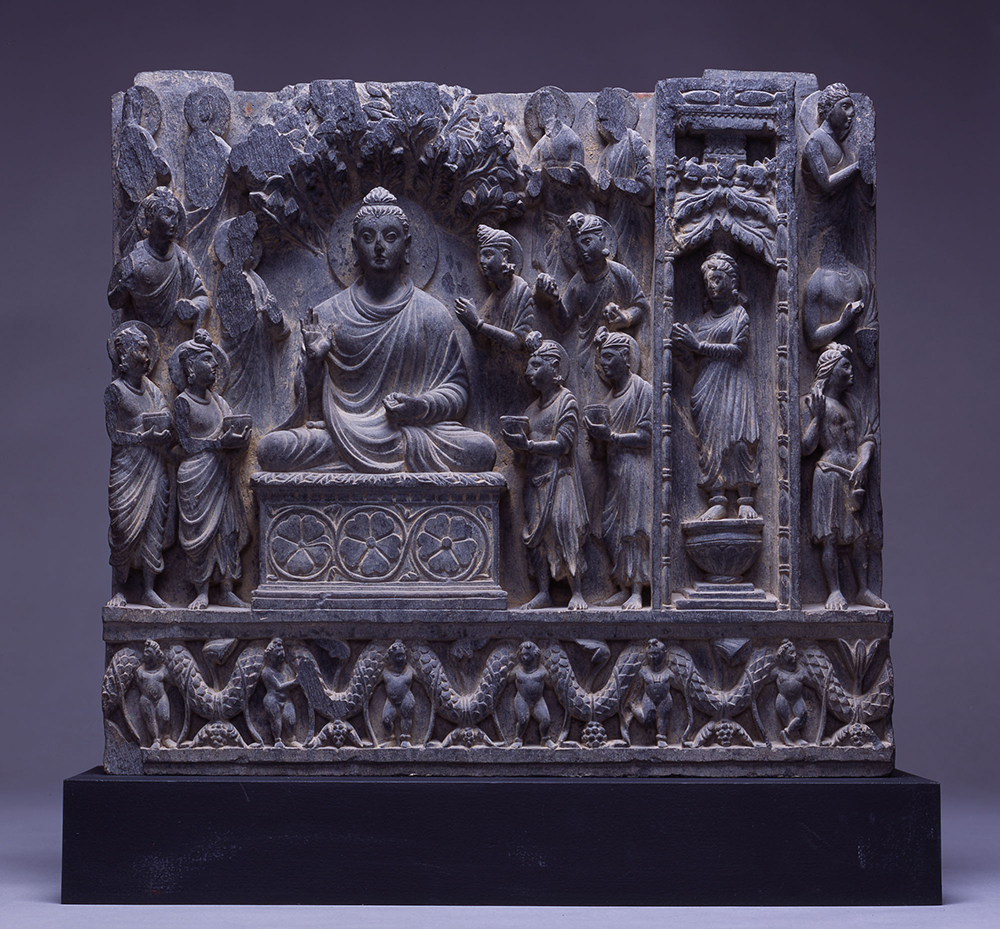
Art and Cultural Exchange along the Silk Road uses the relationships between objects from geographically distinct regions to illustrate the considerable cultural substitution that occurred along the Silk Road. For example, a 2nd-century funerary relief sculpture from Palmyra (in Syria) and a Buddhist narrative relief sculpture from Gandhara (in Pakistan and Afghanistan) both share specific visual characteristics — details of drape folds, ornamental garlands, and decorative columns — that suggest the shut cultural connections between these regions in Asia and the ancient Mediterranean. Similarly, centuries subsequently, a sixteenth-century lintel from a mosque in India bears inscriptions in Arabic and Persian, a cultural mix indicative of the various linguistic, religious, and political traditions deeply embedded in that region and due in large part to the influence of the Silk Route.
"Every bit the works in this exhibition suggest, modern notions of globalization have strong historical antecedence," said Ackland Managing director Emily Kass. "Alone, these objects are interesting and cute works of art, but together they tell an entirely different story about cultural interaction and influence."
In addition to the works of art on brandish, Art and Cultural Exchange along the Silk Road volition apply maps produced by Academy scholars and period maps drawn from the Rare Volume Collection at the Wilson Library to illustrate the paths along which these works traveled. Text panels and related materials explore the objects' visual characteristics and connect them with other forms of historical evidence. Music, food, textiles, and literature are just some of the themes that will be explored in public programs related to the exhibition.
In 2010-2011 public programming for Art and Cultural Commutation along the Silk Route is made possible by the generosity of Philip and Linda Carl.
Image Credit: Unidentified creative person, Indian, Gandhara region; The Offering of the Four Bowls to Buddha, 2nd century; gray schist, 16 3/four ten 18 vii/16 x 3 v/8 in. (42.5 x 46.eight ten 9.2 cm); Gift of Clara T. and Gilbert J. Yager and Ackland Fund, 90.35
Source: https://ackland.org/exhibition/art-and-cultural-exchange-along-the-silk-road/
0 Response to "How Does the Silk Road Impact the Arts of China"
Post a Comment